Dust: An Elysian Tail Message Board

- Oooo, Pretty – Dust: An Elysian Tale Now On Steam
Dust is not often a pretty thing. It’s grimy and chunky and prone to congealing in hairy globules on only the shiniest, most typically attractive surfaces. Also, it’s been locked in an eternal war with lungs since the dawn of time, and I consider mys...
Dust is not often a pretty thing. It’s grimy and chunky and prone to congealing in hairy globules on only the shiniest, most typically attractive surfaces. Also, it’s been locked in an eternal war with lungs since the dawn of time, and I consider myself a close ally of all things breathing-related since they keep me alive. Dust: An Elysian Tale, however, is a different story. Its hand-painted 2D stylings are utterly gorgeous, glowing with color and dancing with life. I want to play it right nowwwwww- oh, I can. Dust has piled on top of Steam, which – in addition to sounding like a physical impossibility – is very good news.
(more…)
- Now Available - Dust: An Elysian Tail
Dust: An Elysian Tail is Now Available on Steam and is 10% off for the first week of launch!Immerse yourself in a gorgeous hand-painted world on a search for your true identity. As the mysterious warrior, Dust, your action-packed journey will take ...
Immerse yourself in a gorgeous hand-painted world on a search for your true identity. As the mysterious warrior, Dust, your action-packed journey will take you from peaceful glades to snowy mountaintops and beyond. At your disposal is the mythical Blade of Ahrah, capable of turning its wielder into an unstoppable force of nature, and the blade's diminutive guardian, Fidget. Battle dozens of enemies at once with an easy-to-learn, difficult-to-master combat system, take on a variety of quests from friendly villagers, discover ancient secrets and powerful upgrades hidden throughout the massive, open world, and uncover the story of an ancient civilization on the brink of extinction as you fight to uncover your own past.


- Grime To Kill: Dust – An Elysian Tail
More news from PAX East, this time via the electronic eyes of Polgyon. Dean Dodrill and Alex Kain told the world that their side-scrolling ARPG, Dust: An Elysian Tail, will be coming to Steam in April. There’s a trailer below, which is handy for people...
More news from PAX East, this time via the electronic eyes of Polgyon. Dean Dodrill and Alex Kain told the world that their side-scrolling ARPG, Dust: An Elysian Tail, will be coming to Steam in April. There’s a trailer below, which is handy for people like me who haven’t played the XBLA original, because Dust means two things in my gaming world: a shooty EVE thing or a platforming sweep ‘em up. This Dust has lots of hacking and possibly some slashing, and anthropomorphic characters.
(more…)

- It's Dangerous to Go Alone
One of the happiest days in Dean Dodrill’s life was also one of his worst.Dodrill’s grandmother, Rosie, had been the hospital the last few months. The whole time, he’d been crunching to finish a playable build of Dust: An Elysian Tail for Microsoftâ...
One of the happiest days in Dean Dodrill’s life was also one of his worst.
Dodrill’s grandmother, Rosie, had been the hospital the last few months. The whole time, he’d been crunching to finish a playable build of Dust: An Elysian Tail for Microsoft’s Dream Build Play contest. The winner received a chance to appear on Xbox Live Arcade and $40,000. In other words, a potential life changer.
Dodrill stands in front of kiosks for PAX East 2012. The game had been in development for more than three years by this point.“The day that the winners were announced, I was actually asleep at home, since I’m a night owl,” he said. “I remember hearing my family celebrating upstairs before they came down to give me the good news. Having crunched so hard to get the build ready, it was a thrilling and validating moment as a budding developer.”
Not an hour later, a phone call arrived. Rosie had passed away.
“That sense of ‘hurray, we did it! But it didn’t matter, you can’t always change fate’ influenced how I continued to write for Dust,” he said.
There are a great many good games, but very few surprising ones. Dust, a beautiful hand-drawn 2D brawler created by the one-man development team of Dean Dodrill, is the latter. Most surprising about Dust wasn’t how ambitious it felt for the product of a single-person studio, but the bold, tragic storytelling.
So much of the conversation about Dust was dominated by polarized reactions to the game’s art, an homage to Don Bluth cartoons that was largely interpreted as furry fandom. (Try to keep that out of the comments?) This distracted people from, perhaps, the biggest revelation of all: it’s a game about, death, hope, redemption, and genocide.
“The Secret of NIMH, in particular, is all about a race of rats being exterminated,” said Dodrill. “I really liked the juxtaposition of this colorful, cute art style and this really dark story, which you don’t really see so much in animated films these days. I think that’s probably where it came from. I didn’t really give it a whole lot of thought."
"I didn't give it a whole lot of thought" is a common theme when it came to conceiving Dust's story.
In Dust, General Gaius and his army are exterminating the seemingly peaceful Moonbloods race, and, frustratingly, they don’t give a good reason why. Moonbloods exist, so they must die. An early sequence reveals Dust, the main character, to be complicit in the genocide. He lead the charge, and the rest of the game involves this character coming to terms with his actions. At the start, Dust awakens, having lost his memory, only to learn he’s a monster.
That Dust wraps such heavy themes within a set of cute, likable characters creates a startling contrast.
The game was largely crafted by Dodrill, but he enlisted help in a few areas, including music and story. For writing, Dodrill eventually connected with Alex Kain, a designer and writer working at mobile developer Venan at the time.
Not long after an early trailer was released for Dust, Kain sent Dodrill a brief message over Twitter, complimenting him on the game, and offering to talk about his design process sometime. Dodrill looked Kain up, and was impressed by the games Venan had worked on. Dodrill reached out, and the two quickly bonded.
“We both really enjoyed Trespasser, even though it’s a terrible game,” said Kain.
(I love you both.)
Early builds of the game had only been shared with the Xbox Live Indie Games community, since Dust was originally going to be released there. Dodrill came to trust Kain, and sent him the game in pursuit of feedback. The build came with a questionnaire Dodrill had been attaching for other testers.
How do you feel about your game experience? Rate it on a scale from one to ten. If you can think of anything you’d want to improve, what would you improve?Rather than just enjoy the experience of an early game, Kain tried to provided legitimate feedback for Dodrill. He felt the story had some interesting ideas, but that it was coming up short in the writing department. This didn’t immediately sit well with Dodrill, the sole mastermind behind Dust until this moment.
“I’ll admit that I was very stubborn when I first met Alex,” said Dodrill.
This wasn’t the first time Dodrill had received feedback about the game’s story. Microsoft partially signed Dust because Dodrill hadn’t just envisioned a game, he’d conceived parts of a larger mythology. In a post-Braid world, Microsoft was interested in bigger and more ambitious games for XBLA. Dust fit that profile, but as Microsoft started to receive builds of Dust, the company was sending similar criticism his way, as well.
“One of the first feedbacks was ‘can it be not so fan-fictiony?” said Dodrill. “They were talking about the actual wordplay--the writing. I thought, ‘I’ll work on that. I’m not really a writer but it’ll be good. Don’t worry about it.’ Then, when I met Alex, he was a little bit more blunt, and he kept bringing it up, which I’ll admit I wasn’t quite used to at the time. I was testing among the Xbox Indie Games community, and the bar is pretty low there. It’s really low. It was even lower back then.”
So Kain dutifully filled out Dodrill’s questionnaire, and came to the last question.
If there is anything else you can recommend please write it here.Then, Kain rewrote the first 30 minutes of the game. The story was kept intact but he rewrote the dialogue.
“I read his stuff and I remember the line that got me, and it’s kind of cheesy,” said Dodrill. “It was when you first do the dust storm and Aura, the sword, says, ‘witness the power of the dust storm.’ Alex rewrote it to, ‘bear witness to the power of the dust storm.’ That little twist. In my mind, it was like...so, that’s what a writer does! It wasn’t incredibly mind blowing writing or anything, it was just that one line, but I was begrudgingly, ‘Yeah, this guy’s a better writer than me.’ I was kind of pissed.”
A comic Dodrill penned mid-development that illustrates how vague the game's villain was for a while.Four months later, Kain was working on Dust. It took four months because Dodrill dragged his feet.
“I thought, ‘If I really care about this project I’ll overlook my personal weakness and bring Alex on.’” he said. “It’s weird, in hindsight, because I can look back and laugh at myself and realize that was pretty childish.”
Dodrill credits Kain with reversing his perspective on what writing can do for a game. Prior to Kain’s involvement, he just rolled his eyes at writing being very important. That is no longer the case, and is informing his future process.
The major beats in Dust never changed, but Kain worked with Dodrill to find ways to ensure the subplots were tying into the broader story. Dodrill admits his approach was largely influenced by his deep love for Japanese RPGs. In its current state, Dust featured a bunch of different areas with their own little stories, and while they may have been interesting in their own right, each had little impact on the story. Kain was tasked with weaving it all together.
When players enter the game’s cave section, it’s not just about saving a family’s father by fetching a batch of magical water, it’s about saving a family’s father by fetching water that's related to General Gaius and what’s devastating the world. In a graveyard sequence, rather than just helping put the soul of an elderly woman’s husband to rest, you learn the husband was a war profiteer who made his riches from the race war tearing everyone apart.
At the center of it all, though, was the Moonbloods facing genocide.
“It’s like, what’s the worst thing you can do in a game?” he said. “How do you hate your villain the most? And genocide seemed to be the obvious answer. I don’t know if I gave it much thought when I came up with the idea but that’s probably where it came from. It’s hard to say. [...] Alex will find that offensive as a writer.”
Dodrill wanted conflict, so there was a war. But why were they fighting? Well, genocide is a good reason for people to really hate each other. There wasn’t a defined villain, but Dodrill figured that could be worked out later. The various races were only animals because he wasn’t interested in developing a unique race of humans. When Kain started working on the game, he tried to find a way to tie all of this together, and the villain was a huge part.
“As a writer, it was a really interesting challenge to have that be the framework for the whole story, and also try to make the antagonist somewhat relatable,” said Kain. “Not relatable but more... sympathetic.”
“When I brought Alex on I didn’t really have a well defined villain and the villain changed quite a bit,” said Dodrill. “Originally it was going to be, ‘we have this bad king in this castle.’ Why is he bad? [...] It was very much Dracula from Castlevania. You have a castle, you have a bad guy...”
When we caught up with Dodrill at PAX East ourselves, he didn't know Summer of Arcade was in his future, pushing up his release date.Despite Dust’s protracted development cycle, eventually push came to shove. The game needed light at the end of the tunnel, and the idea of a release date and pressure from Microsoft forced the duo to start making some compromises.
Neither is happy with the way the game’s introduction turned out.
Dust opens with a character experiencing amnesia, and heading off on an ambiguous quest, a direct result of Dodrill’s inspiration from JRPGs tropes.
“We noticed a lot of people saying, ’The storyline isn’t anything to write home about. It’s an amnesiac character that saves a bunch of people.’” said Kain. “We got the feeling that those people didn’t really play past the first hour or two of the game. If you think that’s what the story is, then I honestly can’t blame you.”
The introduction was originally much, much longer, but Microsoft applied pressure to cut it down.
“Microsoft kept saying you need to trim it down because XBLA games are usually ‘press A to jump’ and that’s kind of it,” said Dodrill.
Dodrill and Kain don’t blame Microsoft for the introduction’s weaknesses. It was one factor among many.
There was a plot hole--or potential plot hole--I asked the two about, though. It’s possible to accept General Gaius despises the Moonbloods just because they’re Moonbloods and that’s enough, but even Hitler had his own awful, misguided reasons, so why not General Gaius? It turns out there is a reason, and it was cut from the game. An exchange between Dust and General Gaius at the end would have explained it. Unfortunately, they ran out of time.
“Every second of cutscene is many hours of work that Dean just didn’t have time because the cut scenes were the last thing to go into the game and he was crunching crazy hours,” said Kain. “He was working like 100 hour days.”
These final passes at the game were happening as Dodrill and Kain were rushing to meet an unexpected entrance into last year’s Summer of Arcade promotion, and Dodrill was expecting a child.
“It was a question of what was going to go gold first: Dust or Charity Dodrill?” said Kain.
Since the line was meant for a cutscene, the two were faced with a huge problem. There was nowhere else to slot the line that made any sense, and there was no time to extend the cutscene to necessitate the line’s inclusion. So, it was cut. It’s a frustrating omission for the player, but one the developers don’t deeply regret.
“I like the fact that when you finally meet him [General Gaius], he thinks he’s trying to save you,” said Dodrill. “He’s obviously doing an evil thing and he almost convinces Dust at the very end, ‘Come back to me.’ I like that he’s not just a straight up monster. He’s not Dracula. I like the fact that we left that sort of ambiguous--unintentionally in some ways, but it was a decision we made.”
There are hopes to produce more games in the world of Dust. The ending provides closure to the specific arc of Dust: An Eylsian Tail, but it’s implied there’s more on the horizon. Dodrill and Kain wouldn’t confirm a sequel was in the works (Dodrill is working on another project right now), but if that ever happened, it would immediately address the history of the Moonbloods and General Gaius.
“He [General Gaius] honestly believes that the Moonbloods are a threat somehow,” said Kain. “We don’t explain what that threat is but that’s something we hope to cover in the future.”
In the near term, Dodrill mentioned that players hoping the game would become available somewhere other than XBLA should keep paying attention.
Dust sold enough copies on Xbox 360, however, to let Dodrill continue his one-man band of game development. It wasn’t enough for him to expand beyond himself, but that’s okay for him right now.
“Alex and I have already chatted about my next game which we’re hoping to announce sometime soon but we’ll see,” said Dodrill. “It’s actually one that I think you and Brad [Shoemaker] will probably hopefully enjoy because you love horror and Brad loves Super Metroid.”
You’re speaking my language, Dodrill.
- Worth Reading: 11/02/12
Once again, kudos to Giant Bomb user Fobwashed for this excellent piece of work. ARGH.I’m putting together this edition of Worth Reading really late on Friday afternoon, moments after having my soul crushed by the never-dying, machete-wielding Jason Vor...
I’m putting together this edition of Worth Reading really late on Friday afternoon, moments after having my soul crushed by the never-dying, machete-wielding Jason Vorhees. You’ll have to forgive me for not having paragraphs of reflection on the past few days, and instead quickly point you to what I’ve gathered this week.
Apologies for not having a game to point you to, though. Rather than suggest a game I didn’t have enough time to vet, I’d rather just cut that section and focus on the material that I can stand behind.
God damn you, Jason. God damn you.
(I will have my revenge on a later episode of Spookin’ With Scoops.)
Hey, You Should Read These
- "What Went Wrong With Silicon Knights' X-Men Destiny?" by Andrew McMillen for Kotaku (this link won't work until Kotaku is back online--the site was knocked offline by Hurricane Sandy)
- "Death March: The long, tortured journey of Homefront" by Rob Zacny for Polygon
Hopefully you had a chance to listen to the podcast this week, in which we spent more than an hour talking about the various issues raised regarding ethics in games journalist in the past few weeks. It’s probably not the last time we’ll have something to say on the subject (and if you have questions, ask!), but rather than delving deeper down that rabbit hole on Worth Reading, I wanted to highlight a few excellent pieces of games journalism filed recently. These are pieces that deserve your clicks, as the only way more of it will be produced is if websites know they can have reporters spending weeks researching material that will only end up in one, big piece. There’s not much of a financial incentive to do that, and we have to support the websites that do engage in that. Bravo to Polygon and Kotaku.
If You Click It, It Will Play
I Don’t Know About This Kickstarter Thing, But These Projects Seem Pretty Cool
- Whatever you think of Gerztron, I wish more Kickstarter games attached prototypes.
- There aren't many god games these days, and Maia proposes being the god of a space colony.
- Sir, You Are Being Hunted should get backed for its name alone. Luckily, it also looks great.
Valve Just Launched Greenlight, So Here’s Some Games That Don’t Look Terrible
- Broforce. Broforce? Broforce! Wait, Broforce. Right. Broforce.
- Heard nothing but great things about Walking Mars for iOS. Maybe I'll just wait and play it here.
- Dino Run is not really a new thing, but if you're into dinosaurs, it's some good, mindless fun.
Oh, And This Other Stuff
- Not everyone wants to have games move them, and that's okay. Journey did that for me, though.
- A colleague, Matt Hughes, passed away of an apparent suicide this past week. Tragic.
- Leave some tablets with Ethiopian kids who've never used a computer, and what do they do? Hack it.
- Someone created a text-based multiplayer shooter. No, I am not shitting you.
- An excellent interview about the state of the industry with Peter Moore.
- Following incidents, GDC has reminded folks about its code of conduct policies. Will PAX be next?
- Whammy Jammy is a game jam about music-based video games, aka my faaaaaaavorite.
- If you haven't played Dust, then play Dust. After that, read this fascinating postmortem.
- It was tragic when games journalism lost Kieron Gillen. His piece on The Cradle is so good.
- Test your video game knowledge in this video.
- A fascinating piece on the so-called "randomness" of XCOM.
- Rami Ismail of Super Crate Box on why Hotline Miami is an importnat game. Warning: spoilers.

- Dust: An Elysian Tale dev had to scrap third of the game
Dust: An Elysian Tail, one of the few highlights of this year's Summer of Arcade, actually had to cut a major chunk of its story to make release. Speaking with Gamasutra, Dust co-writer Alex Kain says they had to cut a third of the game.Creator Dean Dodr...
Creator Dean Dodrill's original vision for Dust had "a massive third act," according to Kain, taking players to new locations, with a new main antagonist and refocused storyline. This would have required months more time the team didn't have, so it was cut.
Kain says, "It was hard to part with the mysterious final villain, but the game ended up a lot tighter, and the story felt much more satisfying ending where it did." Gamasutra has much more on Dust in its extensive postmortem.

- Alone With The Crunch: How a Video Game Pushed One Man To The Brink
#indie The crunch: it's a phenomenon most developers are familiar with. But what happens when you are deep in the crunch without a team to back you up? How does that change things? How do you survive? Dean ...

- PSA: Dust: An Elysian Tail soundtrack is now available
While most of Xbox Live Arcade game Dust: An Elysian Tail is the result of one man's hard graft, Dean Dodrill did outsource its music to the brilliantly named HyperDuck SoundWorks. Today the Northern Irish trio made the soundtrack available for download,...
While we wouldn't be too far off with an awful 'Elysian easy listening' pun, the soundtrack ranges across a number of unusual genres and instruments. There are also a few songs courtesy of Alex Brandon, who worked on the soundtracks for Unreal Tournament, Alpha Protocol, and Deus Ex among others. You can listen to the songs in full on Hyperduck's Bandcamp site. Meanwhile, if you've not yet checked out our review of a certain "beautiful, quirky" adventure platformer, maybe you should.
[Thanks, Alex]

- These Western-developed JRPGs deserve your time
In my drawer is an unopened copy of Muramasa: The Demon Blade. Having really enjoyed it at E3, I made a point to pick up a copy for myself, then proceed to completely forget about it following a trip to Japan. It's still there, waiting for me to finally ...
I thought of Muramasa recently while playing another 2D action RPG - Dust: An Elysian Tail. Dust was developed by a westerner named Dean Dodrill, but it has much in common with Japanese-developed RPGs. The art style and the storytelling are just two elements that seem to take after Dust's Japanese counterparts.
That Dust has so much in common with Muramasa is a reminder that an RPG doesn't have to be developed by the Japanese to be a "JRPG." I've heard arguments to the contrary, but there is definitely a certain style at work in JRPGs, which is most apparent in their console-friendly accessibility, animated look, and their focus on storytelling. These are all traits that can be readily replicated by western developers.

- Dust: An Elysian Tail Review
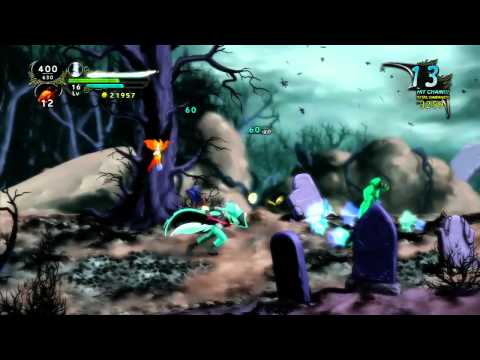
Dust's heart is its exceptionally fast-paced and responsive combo-based fighting system.On first glance, Dust: An Elysian Tail looks like it has a little bit of everything. There's a responsive, lightning-fast combat system that lets you juggle enemies, s...

On first glance, Dust: An Elysian Tail looks like it has a little bit of everything. There's a responsive, lightning-fast combat system that lets you juggle enemies, suplex them out of the air, or combo them several screens high. You've got a full raft of RPG mechanics, so you can level up and distribute skill points, and equip armor and items that buff different attributes and add effects like health regen or increased drop rates. The equipment system goes a step further with a full crafting system that lets you build even better stuff than you can buy, and there's a ton of other peripheral secrets to discover in your travels. All these mechanics are gathered together in service of a memorable, well written storyline, and swaddled in some of the most lavishly produced 2D video game art seen anytime lately.
The core of what makes Dust so rewarding is the quality and immediacy of the combat. You start out with basic abilities to do things like pop enemies up into the air or dash behind them and do a turnaround attack, and soon you get a sword-twirling trick called the dust storm that allows you to juggle multiple enemies, and also amplify the spells spewed by your little flying rodent whatsit Fidget into screen-clearing dervishes of magical destruction. Using all your juggles and spells and other combat moves effectively will net you combo hit counts well into the hundreds, which is especially useful since you earn bonus experience for solid combos. Dust's feedback loop of combat and character progression makes you constantly feel like you're becoming more powerful all the way up to the last minutes of the game, and the controls are so quick and responsive that it just gets more and more fun as you start laying waste to a dozen enemies at a time with ever increasing style.
The game has picked up a reputation as a Metroidvania game, and Dust does have the grid-like map that's the hallmark of that sort of game, but the similarities to something like Shadow Complex are partially superficial. Dust doesn't offer a single contiguous world that you can navigate from end to end, but rather a bunch of different smaller areas that you warp between on a world map. And once you get inside one of those areas, the graph-paper map doesn't follow your every move; each map square only corresponds to an entire "screen" that might take you five minutes to work your way across. That expectation of using the map to pinpoint exactly where I was at all times kind of threw me for a loop when I first started playing Dust, since you still end up fumbling your way around a good bit within complex screens, but once you unlock the world map and get a feel for how everything is put together, the game makes perfect sense. It helps that Dust does share that central Metroidvania conceit of taunting you with areas you obviously don't have access to early on, then doling out abilities like a slide and double jump later on that give you access to those areas, giving you a lot of reason to backtrack.
There's plenty of story and side quests to keep you busy for at least a dozen hours.Actually, I was surprised how much time I wanted to sink into going back and looking for secrets. The game is chock-a-block with hidden treasure chests that hold most of the best items and crafting recipes in the game, and a lot of those chests are very well hidden in clever places in the environment. Those are just the nuts-and-bolts secrets, though. What's even more memorable are the dozen notable characters taken from other Xbox Live Arcade indie games that are deeply hidden throughout Dust's expansive levels. It takes a lot of work to find some of these guys--one of the solutions had me getting a clue from a note I found in a completely different area, then kneeling in a specific spot like I was playing Simon's Quest all of a sudden--and they reward you with health bonuses when you find them. More importantly, you really have to see for yourself the amount of detail and craft that went into making each secret character's area feel visually and thematically consistent with the games they're taken from. Dust goes to the extreme lengths of changing its own art style, visual presentation, and mechanics in some cases to emulate and pay homage to these other standout downloadable games, the ranks of which this game is likely to join in the near future.
Aside from the secret stuff, Dust has a good 10 or more hours of pure story and side content, including a bunch of optional quests you can pick up from friendly characters in multiple towns. The game becomes occupied with some fairly dark themes, as you delve into the story of the skilled warrior Dust who, together with Fidget and his ancient talking sword, sets out on a quest to figure out who he is and where he came from. Yes, an amnesiac protagonist--I can hear you rolling your eyes from here. But the game's finely crafted storytelling efforts keep that clichéd premise from feeling out of place, even as the nature of the truth becomes more and more grim. The game encompasses a broader scope the more you play, as you realize who's involved in the central mystery and how much is at stake, and the story ultimately reaches a more satisfying and emotionally resonant conclusion than most 60 dollar retail games I can think of.
The soft focus and fluid animation are awfully easy on the eyes.At the same time, Dust is almost paradoxically bursting with an ebullient brand of charm. There's a ton of referential and self-aware humor that makes light of video game conventions in general and a number of memorable games in particular. (The very first item you pick up is an amusing reference to Symphony of the Night, which is a clear influence here.) The game tastefully knows not to lean too heavily on this stuff, ensuring that it never crosses the line and becomes too cloying or corny. Dust juggles light and dark in a way that makes it easy for you to feel good about, even if you haven't spent any time seriously considering talking animal characters since the last time you watched An American Tail or Disney's Robin Hood. All this is enhanced by a cast of excellent voice actors who do both the jokes and the plot a service, giving uniformly well considered line readings that make you feel like someone who really knew and cared about the material was sitting there directing them the whole time.
That Dust is largely the work of one lone developer makes it all the more impressive, but the circumstances of the game's development aren't even a consideration when you consider how good the game is at face value. Cramming this many elements into a single downloadable game seems like an audacious move, but Dust pulls it off with confidence, style, and heart, resulting in a game that deserves to be played by a lot of people.

- Dust: An Elysian Tail review - A classic formula revisited
Every so often, a game comes along that reminds me why I play games. They aren't always perfect, but they're memorable experiences and that's what really matters. Dust: An Elysian Tail is one of those games. It certainly has its flaws, but when you get ...
- Quick Look: Dust: An Elysian Tail
Brad and Jeff examine one man's labor of love as it caps off this year's Summer of Arcade.
- Dust: An Elysian Tail Review
Sometimes, when you want something done right, you have to do it yourself. Even in video game development. Find out why Dust is a one-man marvel.
Sometimes, when you want something done right, you have to do it yourself. Even in video game development. Find out why Dust is a one-man marvel.

- Dust: An Elysian Tail Developer Commentary
Dig the first 10 minutes of Dust narrated by the game's creator!

- Dust: An Elysian Tail launch trailer told
This year's XBLA Summer of Arcade has been a mixed bag (putting it politely), but there are highlights, like this week's Dust: An Elysian Tail. Here's the launch trailer for a game that we'd quickly describe as Tales of Metroidvania.
- This Gorgeous Action-RPG Was Made By One Man
#dust Here's a first look at Dust: An Elysian Tail, an upcoming action role-playing game that will be out this summer for the Xbox 360. More »

- PAX East 2012: The Man Behind Dust: An Elysian Tail
How does someone with no prior programming experience make an Xbox game all by themselves?

- Dust: An Elysian Tale bounding to XBLA in 2012
Despite the relative silence on Dust: An Elysian Tail since it won 2009's "Dream-Build-Play" competition, one man has been playing it daily for years now. That exclusive audience is the game's developer, Dean Dodrill, who says the game will finally be ...
"It's coming out in 2012, promise," Dodrill wrote under his pseudonym "Noogy" on the Neogaf forums. He doesn't give any other details, or even a more specific launch window, but we've reached out for a more definitive date.

- Debut Trailer
A world full of adventure and wonders needs defending.
