BioShock: Infinite Message Board older than one year ago

- 2K Australia is 2K Australia again and is working on BioShock Infinite, Levine confirms
So we don't run the risk of burying the lede, let's start with the news: MVC Pacific reports that the Canberra, Australia-based arm of developer 2K Marin is once again known as 2K Australia and is now working with former sister studio Irrational Games ...
He added, "If every decision was this easy..."
Now, some history. In 2007, after Irrational Games was purchased by Take-Two and just before the release of the original BioShock, the studio was split apart and renamed 2K Boston and 2K Australia. Since then, 2K Boston has become Irrational Games, once again, but 2K Australia hasn't had it so easy.
After working with 2K Marin on BioShock 2, it was decided that 2K Australia would lose its name and become a part of 2K Marin (which is a tad geographically misleading, no?) and help develop the XCOM reboot. Less than a year later, the 2K Australia studio head Martin Slater resigned and just last month it was reported that 15 employees were cut from the studio.
And now, over four years after the creation of 2K Australia, 2K Australia is back and once again working with Levine's team in Boston. We've reached out to 2K Games for any additional commentary on the shuffle and whether or not 2K Australia has any more involvement in XCOM. But while we're waiting, we wanted to say "welcome back" to the team in Canberra. Oh, and enough navel gazing. BioShock Infinite isn't going to make itself.

- BioShock Infinite: Creating a Monster
Irrational's BioShock Infinite is one of the most promising games scheduled for release in 2012. Combining incredibly detailed visuals with interesting gameplay mechanics, the glimpses we've seen so far have been especially impressive, earning Infinite IG...

- Rational Discourse: Levine And Del Toro
Do you enjoy conversation between passionate individuals? If so, the recent Irrational Interview featuring Ken Levine and Guillermo Del Toro is a thoroughly enjoyable way to spend an hour of your day. The Mexican author/director is working on a horror ga...

Do you enjoy conversation between passionate individuals? If so, the recent Irrational Interview featuring Ken Levine and Guillermo Del Toro is a thoroughly enjoyable way to spend an hour of your day. The Mexican author/director is working on a horror game and the first part of this audio was posted on Halloween so I expected a focus on spooky happenings but the conversation is much more wide-ranging. There is some discussion of monsters but mostly it’s two men discussing the joy of the creative process, as well as the frustrations that can arise in the film and game industries.
Del Toro is frank as ever, at one point describing working on projects with no personal interest as like trying to “*crag* without a boner”. He does swear a lot. Ken slowly warms to the idea of this navvy-like behavior and by the end they’re both at it. Two parts. Downloads here and here.
(more…)

- PS Move Controls 'Working' on BioShock Infinite
Irrational Games, the studio behind BioShock, is unequivocally a hardcore game developer. That's why it surprised so many gamers when, at Sony's 2011 E3 press conference, BioShock Infinite's Creative Director Ken Levine revealed that BioShock Infinite wou...
- Ken Levine Interview: Taking BioShock from Rapture to Columbia
BioShock is one of the most surprising games of this generation. First of all, it isn’t inspired by a real-life conflict, a film or another game series, but a moderately successful novel called Atlus Shrugged by Ayn Rand, which put forward a philosophy ...
BioShock is one of the most surprising games of this generation. First of all, it isn’t inspired by a real-life conflict, a film or another game series, but a moderately successful novel called Atlus Shrugged by Ayn Rand, which put forward a philosophy called Objectivism, or ‘rational selfishness’.
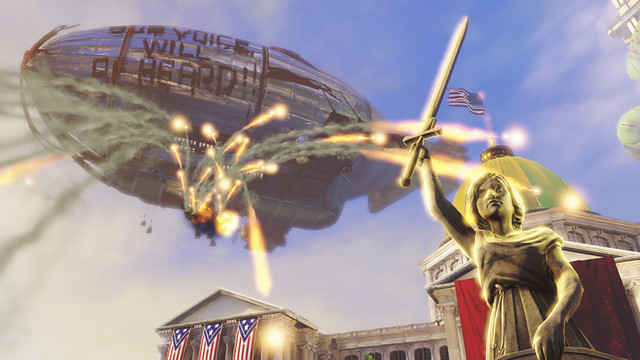
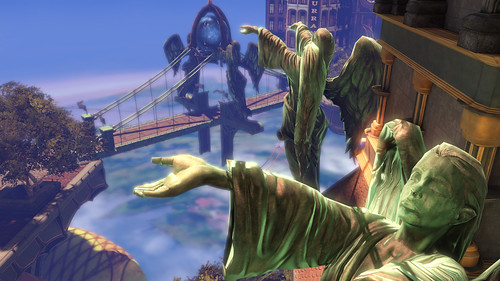
BioShock’s writer and Creative Director, Ken Levine, and his team are now working on BioShock Infinite, a departure from the dark, dystopian corridors of Rapture into the bright skies of Columbia, a floating city named after the female personification of the United States of America. I recently had the chance to sit down with Ken to talk about the philosophies that underpinned the original BioShock and how, if at all, these are being applied to BioShock Infinite.
PlayStation.Blog: What’s more important to you: surprising the player or making existing fans feel familiar?
Ken: When you look at BioShock Infinite, you can’t deny that it’s a BioShock game. However, and this might seem counter-intuitive, Rapture was a surprise to the player; you wanted to see what was around each corner because it was so strange. If we were to take you back to Rapture then that surprise element would no longer be there. Weirdly, we had to change BioShock in order to make it BioShock, or at least to retain that core principle of the unexpected.
I think the important point for us is that BioShock Infinite has the same roots as the original, and in part those roots are me, Nate, Shaun, Steve and all of the guys in my team who worked on it. In terms of the game itself, we’re talking about the depth and detail of the game world, the kinds of weapons you’re going to have, the freedom of the combat and the character growth system that we’re going to be showing later.
I’m not saying we can never go back to Rapture, but it would need to be in a way that was fresh and new.
PlayStation.Blog: What is your favourite moment in the original BioShock?
Ken:The two moments of BioShock that will always be special to me as writer and creative director are the opening descent to Rapture and the encounter with Andrew Ryan. We really put ourselves out there on the latter because it was a boss battle where you don’t actually fight the boss, but that was fundamental to the story, the fact that you had no choice in how it played out. We are thrilled that it worked so well because it was such a risky moment.
I don’t think people give gamers enough credit and assume that they only want explosive, visceral experiences. We also want to be mentally stimulated. The fact that the scene resonated so much proves that we are more diverse in their tastes than some think.
When faced with a choice between protecting and destroying in games, point in case being the dilemma of whether to rescue or harvest the Little Sisters in BioShock, do you think we are innately drawn to one or the other?
Well we don’t have any kind of metric to track that particular example but we do have anecdotal evidence. I do a podcast called Irrational Interviews and I was talking with Guillermo Del Toro on there. He said that he harvested in front of his two daughters and they got really mad at him. My sense is that people generally rescue and I think that decision is an emotional one rather than a logical one.
I believe players have an inclination to what we might call ‘disruptive’ actions, such as jumping around when another character is talking, but I don’t get worried about people doing weird things; games are about the player doing what they want and they are generally there to try and experience every interaction available. It’s their game.
PlayStation.Blog: And yet protection seems to be a running theme in BioShock games. Is this a conscious design decision?
Ken: I see what you mean in that you have Big Daddies and Little Sisters and there’s some kind of protective relationship going on there. With BioShock Infinite it’s important to point out that you’re not escorting Elizabeth all the time – she is capable of taking care of herself and she is more like a partner in your mission. But she is looking to your experience in combat. She has never fought but Booker has a rough past and a lot of combat experience.
The basic notion of protecting is one of the noblest things we can do for each other and those relationships can be beautiful in game form. Just look at that moment when you first take Yorda’s hand in Ico. In BioShock games we like to explore how those relationships can have both a dark and a light side. When a Big Daddy protects a Little Sister, he is also exploiting her by making her gather ADAM. In BioShock Infinite, when Booker finds Elizabeth she is locked in this tower with Songbird, who is her only companion but also her jailor.
Those are the challenging relationships that we are drawn to.
PlayStation.Blog: If you’re faced with a potential fork in your design choices, where either narrative or gameplay benefits depending on your decision, which one usually wins out?
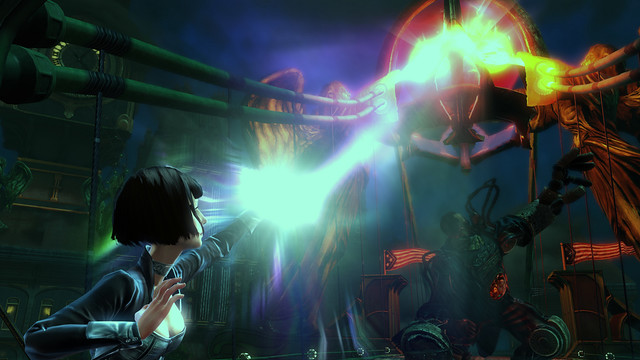
Ken: You have to reach a decision that benefits both. We had a dilemma early in the development of BioShock Infinite with the character of Elizabeth. We needed to ensure that her powers made sense to both narrative and gameplay. We knew we had this character that was going to be extremely powerful, but we didn’t know exactly what those powers were going to be. It was a tough job making sure that what she does from moment to moment in the context of the gameplay suited her role in the overall story. We generally don’t choose; we tweak from both sides to get unity, and if you don’t get that unity, then we tend to jettison things.
PlayStation.Blog: How exactly are the PlayStation Move controls going to work?
Ken: We’ve got the Move controls working now back at the studio, certainly more so than we had when we announced it at E3, and really we’re just waiting for the opportunity to show that with a new piece of content. It’s working well but we still have a lot of polishing to do. Of all the motion controllers in the world, the Move is the one best suited to a first-person shooter, and a lot of PlayStation games have done a great job incorporating it. I will say that we’re discovering some great opportunities with the Skyline gameplay, but rather than show it to people with an old demo, I’d prefer to show it with a new piece of content.
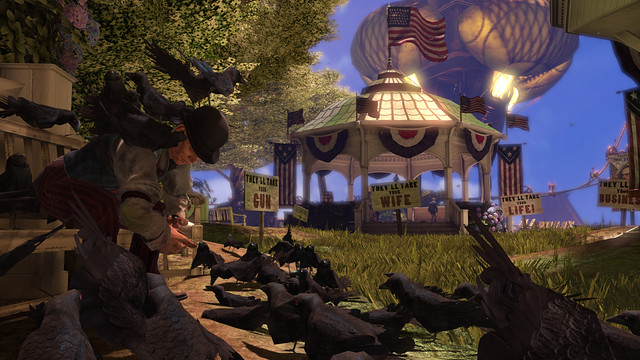
PlayStation.Blog: BioShock famously took inspiration from Ayn Rand’s Atlus Shrugged. Does BioShock Infinite have a particular philosophical or literary influence?
Ken: I read a lot about history and I got interested in the late 19th century by the book Devil in the White City by Erik Larson, which is set around the 1893 World Fair. For me, that time is the most transformative in history because you had all these technologies coming into play, like radio, movies, electricity, cars – mass production in general. Alongside that, you had social transformations with suffrage, labour movements, the beginning of the civil rights movement – all these amazing uprisings bringing a sense that the colony is starting to buckle and break free.
Just look at what was happening in science, with Heisenberg, Einstein and Max Planck; they were discovering that the Universe is so much more complex than anyone thought, and we’re still figuring out the implications of their findings to this day.
In the original BioShock we tapped in to Crick & Watson and their discovery of genetics. In BioShock Infinite we’re looking more at the world of physics and we bring that in through Elizabeth, who is able to manipulate her universe. We’re always looking at the technological, scientific, social and cultural changes that are happening in any historical period we touch, and we try to integrate those into our stories.
Originally, we conceived the game as a struggle between a technological movement and a Luddite movement, and it didn’t work out because, in reality, those Luddite movements never took hold in a powerful way, so we didn’t have such a rich well of inspiration.
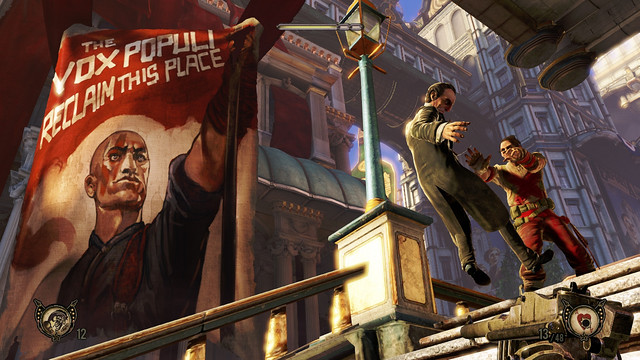
What we have arrived at is a conflict between the Founders, an ultra-nationalist group that is the dominant power in Columbia, and the Vox-Populi, an international workers’ movement that is fighting against the Founders, kicking all of the rich people out of their part of town.
The real conflict of that time – and, you could argue, what is happening today – is this left and right schism of extreme nationalism on one side, and an anti-capitalist, internationalist movement on the other. With our games we’re never looking to advocate a political position and we try to ask questions more than we try to answer them. We show the extreme ends of the spectrum.
The Splicers in BioShock were insane, almost feral, but the enemies we have seen in BioShock Infinite seem more lucid. How does this affect the game?
You’re going to see a range of enemies in terms of where they’re at mentally. It’s not like BioShock where you’re showing up after an event and picking up the pieces; Elizabeth and Booker are in the middle of it all. The Vox-Populi is a small group when you show up at the beginning of the game, and your actions change that and accelerate their growth. You’re going to see changing AI based on your actions. Then you’ve also got SongBird and Handyman – examples of bigger, stronger enemies.
PlayStation.Blog: How does it make you feel when you hear that some players completed BioShock almost exclusively using the Electro Bolt and the shotgun?
Ken: One of the first things we did when we started on BioShock Infinite was to draw a graph with y and z axes, and to say that one of those axes was the number of enemies in an encounter and the other was the range of those enemies. In the original BioShock, the entire game lived in one corner of that graph – few enemies, all at close range — so the Electro Bolt and shotgun were perfect. BioShock Infinite is going to have much greater ranges and, potentially, far more enemies, so we’re greatly increasing the spectrum of encounters that are possible, and that requires the player use a broader set of tools.
That being said, it may be a given player will try to find a way to close down those distances and stick with Electro Bolt and shotgun, but I don’t think that’s going to be anywhere near as effective a strategy this time around. They were too devastating in BioShock, we admit that, but we’re not going to solve it by simply nerfing those weapons; we’re doing it by changing the types of encounter you’re going to face.

- Going even deeper into BioShock Infinite's voice acting
Last week we brought you the first half of a two part feature with Irrational Games head Ken Levine coaching BioShock Infinite's two main voice actors. This week, we've got Booker (Troy Baker) yelling at Elizabeth (Courtnee Draper) to elicit emotion-f...
Last week we brought you the first half of a two part feature with Irrational Games head Ken Levine coaching BioShock Infinite's two main voice actors. This week, we've got Booker (Troy Baker) yelling at Elizabeth (Courtnee Draper) to elicit emotion-filled lines. Next week? Tigers.
- BioShock Infinite's main voice actors explore the creative process
What's it like expressing a total lack of remorse for a dying virtual horse in a fantastical city in the clouds? BioShock Infinite voice actor Troy Baker explains just that in this behind-the-scenes look at the voice actors playing Elizabeth and Booke...
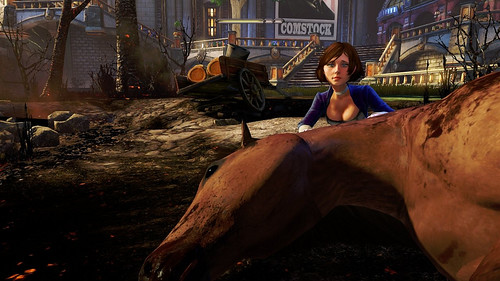
What's it like expressing a total lack of remorse for a dying virtual horse in a fantastical city in the clouds? BioShock Infinite voice actor Troy Baker explains just that in this behind-the-scenes look at the voice actors playing Elizabeth and Booker in next year's big Irrational game.

- Too many chefs: Ken Levine's thoughts on auteurship, editorship, and his work on the BioShock film
When it comes to the development behind BioShock 1 and BioShock Infinite, Irrational Games studio head Ken Levine described his role as that of "editor of a magazine ... but I'm also a writer for the magazine," putting things into terms that my word-ad...
That aside, Levine was clear that his role on Infinite is absolutely that of creative lead, not just creative oversight. "This is my game. And I love the fact that we sit down and chat with each other [Levine and other game devs outside of Irrational], but at the end of the day ... this thing's gotta be my decision."
When it came to the translation of BioShock 1 from game to film, however, Levine's role changed -- even though he had been creative lead (head editor?) during the game's development. "If I were to make a game that was based on somebody else's franchise, you need somebody there who's going to say, 'This is true to the franchise, this isn't true to the franchise.' So that was more my role in the film," he explained.

- Irrational's Ken Levine on BioShock's final boss and how Infinite's solution is 'more in our wheelhouse'
"So every game we make, we always say to ourselves -- back on BioShock 1, we had that terrible showdown fight at the end -- we're not good at that, let's not do that again. And then somehow, we end up ... it's like ... 'Baby I'll never hit you again, I...
Irrational Games head and BioShock 1 creative lead Ken Levine struggled through that explanation this past weekend, pausing often, sighing a lot, and doubling back to be extra clear. His sentiment was certainly definitive, though: even he wasn't a big fan of the game's final boss fight with Atlas. "I think the boss battle in BioShock 1 -- the real boss battle -- is Andrew Ryan."
I had asked about how BioShock Infinite, the studio's next game, would deal with boss fights, as the Atlas battle in the first BioShock title was seen by many as the lowest point in an otherwise spectacular experience. "I think we need to stay in our wheelhouse," he explained. "We're not Shadow of the Colossus. Those guys have a genius for that. We don't have that particular genius." Without getting into anything specific, and recognizing that it would be a "missed opportunity" not to do something with Songbird (Infinite's airborne antagonist), Levine said gamers should expect something more akin to the Andrew Ryan resolution in BioShock 1.

- Which Game Is the Best Match for This Steampunk Xbox 360 Controller?
#xbox360 As a trend, steampunk may be yesterday's fad. And, while this custom controller—created by the folks at MorbidStix— apparently been around for a while, it just popped up into view aga...
- BioShock: Infinite voice actors caught on film
Eager to put faces to the voices (and digital faces, we guess) behind the lead characters of BioShock: Infinite? Look no further, as MSNBC's In-Game took some time to chat with Courtnee Draper and Troy Baker, who play Elizabeth and Booker Dewitt in Ir...
Eager to put faces to the voices (and digital faces, we guess) behind the lead characters of BioShock: Infinite? Look no further, as MSNBC's In-Game took some time to chat with Courtnee Draper and Troy Baker, who play Elizabeth and Booker Dewitt in Irrational's upcoming followup.
Check out the video above for a look at the voice acting process, and just what goes into creating Booker, Elizabeth and the relationship between them.

- "New" BioShock Infinite Trailer Makes a Mockery of the Monorail
#bioshock I'm not a scientist, so I can't tell you exactly much of this new BioShock Infinite trailer (commission for the Tokyo Game Show) is actually new. So let's just guess and say "some". More » ...

- Sky’s No Limit: BioShock Infinite At TGS
There will inevitably be an English language version of this video available four seconds after I post this, but I feel compelled to make everyone watch it right now. It’s a short BioShock: Infinite trailer from TGS and I find it hugely exciting. There...
There will inevitably be an English language version of this video available four seconds after I post this, but I feel compelled to make everyone watch it right now. It’s a short BioShock: Infinite trailer from TGS and I find it hugely exciting. There’s some nattering at the beginning, in Japanese, but once that’s done with it’s all action in the universal language of “my word, this is rather thrilling”. It does show some sequences that those wanting to go in completely fresh may not want spoiling, although it’s enemy types rather than plot. Then again, for all I know, the dialogue at the beginning may give away a huge plot twist. It’s unlikely though, isn’t it? Still, if Japanese is something you understand, certainly don’t go telling the rest of us if Elizabeth reveals she’s a sledge.
(more…)

- BioShock Infinite PAX panel video explores the importance of relationships, crying in tiny rooms
PAX can be a fantastic catalyst for news and breaking information about upcoming games, but it also provides a unique window into the development process that we as consumers don't often get a chance to see. This year's BioShock Infinite panel, for in...
PAX can be a fantastic catalyst for news and breaking information about upcoming games, but it also provides a unique window into the development process that we as consumers don't often get a chance to see. This year's BioShock Infinite panel, for instance, dove into the art of voice-acting, the challenges associated with dynamic story telling in a first person environment, and the benefits associated with crying in a 5-by-6 closet while strangers viciously berate you.
The panel, hosted by G4's Adam Sessler, starred Irrational Games' Creative Director Ken Levine, as well as voice actors Troy Baker and Courtnee Draper, who voice Infinite's Booker DeWitt and Elizabeth, respectively. The group covered a wide range of topics regarding Infinite's lead characters, their motivations, and the somewhat unorthodox techniques used to extract such emotional performances from the actors.
Despite being fairly F-bomb heavy, the above video doesn't disclose any information we weren't already aware of, so the spoiler-cautious among you need not worry.
- The Evolution of a BioShock Infinite Scene, in Two Minutes
#bioshock Let's watch how one of the in-game scenes from BioShock Infinite was made, from storyboards to final version, shall we? Your narrator is BioShock creative director Ken Levine. More » ...
- BioShock Infinite's Actors Berated Each Other to the Point of Tears to Get the Scene
#pax At PAX 2011 today, Irrational Games and the two lead actors in BioShock: Infinite gave us another good look at what goes into the voice acting of parts in a virtual medium that has such a complicated...

- Liveblogging the Bioshock: Infinite Panel at PAX 2011
#pax Ken Levine, the mind behind BioShock will anchor a panel alongside Troy Baker and Courtney Draper., the two lead voice actors in BioShock Infinite, beginning momentarily at PAX 2011. Won't you join Ko...

- BioShock Infinite Gamescom screens make Elizabeth sad
Don't cry, Lizzy! We know it's going to be a while before we get to meet, but it doesn't mean you have to be all dramatic about it. Turn that frown upside down! Besides we hear your tears can do dangerous stuff -- wait, not those kind of tears? Oh, got...

- Four New Bioshock Infinite Screens and a PAX Panel You Might Want To Catch
#bioshock Just about any new Bioshock Infinite news is good Bioshock Infinite news. Today the fine ladies and gents over at Irrational Games released four new screens—two are different, provocative a...

- PayPal Billionaire Continues Work Towards Making Bioshock's Rapture a Reality
#bioshock We haven't heard anything on this since 2008, but The Daily Mail reports that Peter Thiel, the founder of PayPal, is continuing his work towards making a Rapture-esque "Start-Up Country" off the...

- If Bioshock Infinite Encourages Cosplay Like This, I'm All For It
#bioshock Russian cosplayer Ormeli offers her take on Bioshock Infinite's "Elizabeth", the emotive sidekick that accompanies you throughout your adventure in a time-rent floating city. It's a little bit Al...
- BioShock Infinite time rift uses assets from canceled Irrational project
The most striking moment of the thoroughly striking E3 demo for BioShock Infinite was, undoubtedly, the moment in which Elizabeth momentarily loses control of her powers, opening a rift to a much, much more modern world than that of the floating city o...
Levine added that the development team "made a bunch of changes to really sell it, but we had all those assets just sitting around from a game we never shipped." Well, great. Now we're going to spend the day trying to guess what that canceled game was. Maybe The Lost? We don't know if a PS2 game could look this good, though. Maybe it's something secret, like Freedom Force: Rise of the Multiplex Menace.
No, that's probably not it at all.

- That Awesome "Revenge of the Jedi" Moment in Bioshock Infinite? That Came from a Game We'll Never See
#bioshock Near the beginning of the E3 demo of Irrational Games' Bioshock Infinite, there's a moment when... well, it's the sort of thing that when you talk to other people who have seen it you say, "You k...

- But, Ken Levine, Will BioShock Infinite Be Worth Playing a Second Time?
#bioshock I expected the official PlayStation Blog to quiz BioShock mastermind Ken Levine on PlayStation topics like 3D and the Move. I expected him to drop intriguing comments like one about how sniper ri...

- Ken Levine talks BioShock: Infinite on PS3, Move functionality
Do you really need an excuse to watch Ken Levine talk about BioShock: Infinite? Fine, for starters, he discusses the game's PlayStation Move support and his thoughts on the Vita. Second, he's rocking a sweet beard. Now watch it already. When you're don...
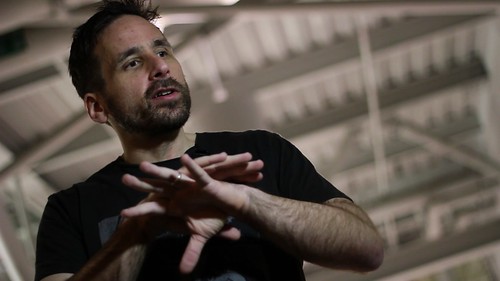
- BioShock Infinite Q&A: Ken Levine’s PlayStation Moves
It’s always a pleasure to speak with Ken Levine, creative director for the award-winnging BioShock and the PS3 dystopian epic BioShock Infinite. Ken’s been good enough to drop by the PlayStation.Blog before, bringing news of PlayStation Move support a...
It’s always a pleasure to speak with Ken Levine, creative director for the award-winnging BioShock and the PS3 dystopian epic BioShock Infinite. Ken’s been good enough to drop by the PlayStation.Blog before, bringing news of PlayStation Move support as well as an upcoming PS Vita BioShock game, but we’ve never been able to immortalize him in crisp HD video.
Until now. In Rey’s lovingly produced video feature, Levine lays out his plan for Infinite domination, starting with creating a convincing relationship between lead characters Booker and Elizabeth as they seek to escape the crumbling city of Columbia. Levine also touches on the origins of Songbird, a biomechanical beast that has jealously locked Elizabeth in the depths of Columbia since her birth. Songbird completes a warped sort of love triangle between Booker and Elizabeth that promises to play out in the game in a big way. “There’s a lot of mystery around Songbird, and I think people will be surprised by his relationship with Elizabeth — it’s a complicated relationship that has elements of light and elements of darkness.“ Levine also muses on the PlayStation Move motion controller and Killzone 3′s much-praised FPS implementation, as well as his instincts on PS3 gaming as a whole. “I think the platform is really hitting its stride right now,” he told me. “The exclusives have been great and it’s been a really interesting platform to watch develop.”
PlayStation.Blog: How is work proceeding with the PS3 version of BioShock Infinite?
Ken Levine, President and Creative Director, Irrational Games: Look, I’m not blowing smoke here. We were Xbox-first for the original game, and now we have something to demonstrate to the PlayStation 3 audience. We love the platform. I have three PS3s at my house. It’s a great game system and I love the kinds of games that are coming out on PSN.
The PS3 has a different architecture than we had encountered before, but because we helped port BioShock to the PS3, we’ve become very familiar with it. And we have a new engine for BioShock Infinite, so we started the game knowing we’d be on PS3. We started thinking about how to leverage the multiple cores from the start of development, so we’re in a much better place this time on PS3.
PSB: Are you working anything into BioShock Infinite that you wanted to include in the original game but couldn’t?
Levine: Combat, for one. In the original BioShock, we gave people this huge tool set but never demanded that they use it. We want to expand the player’s gaming vocabulary — I think that’s one missed opportunity with the original BioShock.
So now we have these traditional BioShock spaces, but also big, expansive areas where enemies are hundreds of yards away. You’re fighting one guy, or 15 guys, so crowd control becomes meaningful. Long-range weapons like sniper rifles become very meaningful.
PSB: What’s been the most challenging aspect of creating BioShock Infinite?
Levine:With this game we got behind this idea of building this relationship between Booker and Elizabeth. We’re really focused on a relationship that is earned, a relationship that is believable. Our focus is, what forms a bond between two people? Making sacrifices for each other — that will build a relationship very quickly. Not just, “these two people are drawn together because they’re attractive.” The same way that in BioShock, I didn’t want Atlas to betray the character so much as the gamer. When Andrew Ryan tells you that you’ve been manipulated the whole time, you think, “Screw you, man!” In the same way, I want the player to build this relationship with Elizabeth in BioShock Infinite. That’s the challenge of what we’re doing.
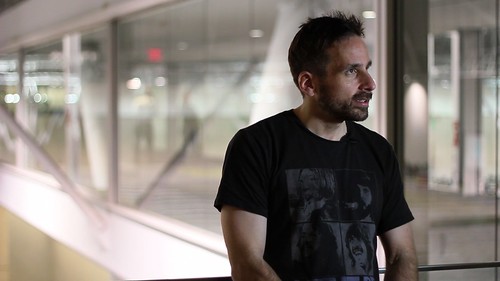
PSB: Replayability is a hot topic for single-player-focused games. Have you been thinking about ways to encourage replay, maybe a New Game Plus mode? Is that up for debate?
Levine: I’ll just say that yes, we do think a lot about this topic. I can’t talk about what we’re thinking specifically. If we’re going to do it, we want to find a BioShock way to do it. People will see more as time goes on.
PSB: Are you intrigued about any gaming applications for stereoscopic 3D?
Levine: For me, it’s all about having something interesting to say with it. I’m never interested in technology in terms of checking a box. We didn’t do multiplayer for BioShock because we thought we would be checking a box if we did. Anything we do has to be unique, interesting, and be appropriate for the game.
So we’re thinking about that stuff now. So if we have that, then that’s a road we may go down.
PSB: What’s your secret for building mystique and mystery in a game like BioShock Infinite?
Levine: I think it’s an issue of detail, of the creators not being satisfied until they really understand their worlds, which takes time to develop. Some creators carry these things in their heads for a long time, or have had a lot of time to make a lot of mistakes.
It’s about consistency, having a consistent aesthetic. It’s difficult. It requires that you not be satisfied with any old thing. It’s the difference between some guy making a crappy action film versus the Coen brothers. They care about the details, they care about the consistency from frame to frame. Each Coen brothers movie feels like a full world. Look at A Serious Man versus True Grit versus Miller’s Crossing. They’re such different worlds, but they’re so rich. There’s no magic formula: It comes down to sweating all the details.
PSB: Based on your Tweets, you’re pretty positive on PS Vita. What do you like about the concept?
Levine: I’m a gamer, right? I like playing games on iPad… but deep down I want that level of control. What’s cool about PS Vita is that it seems to have all the benefits of an iPad-type device with the touchscreen and motion controls. But it has dual analog sticks….and I love shooters. You can finally play a shooter, a real shooter, on a handheld. Seriously, that’s a hole in my soul right now. Now I’ll have something I can play real shooters on, and that’s really important to me. It’s awesome.
I Tweeted a while ago that it did everything but make me an omelet. It sort of has everything and the kitchen sink in it, which is great as a gamer.
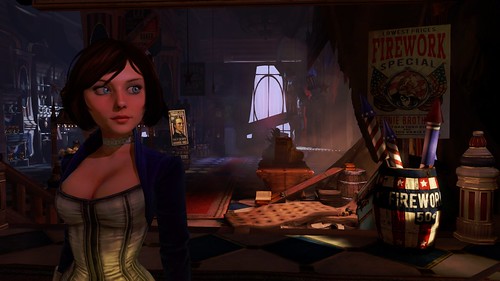
PSB: Andrew Ryan thought free enterprise was the solution to the world’s problems; the citizens of Columbia seem to think it’s purity. What does Ken Levine think?
Levine: [laughs] I don’t like to say what I think. It would just get in the way of what the games are saying. I love that some people play BioShock and think that I’m an Objectivist, or that I’m a rabid anti-capitalist. I don’t really Tweet much about politics, not because I don’t have opinions but because we make games that touch on politics.
If you’ve played the games, I think you can probably suss where I’m at. We tend to make games about characters caught between larger forces. They’re just trying to get by, and they’re surrounded by ideologies and incredibly powerful people. I think a lot of people feel that way. I sure do. I have strong feelings about this or that…but the only thing, politically, that I come out about is gay marriage, which I feel so strongly about. People should be able to marry who the hell they want, and it affects so many people that I care about. I’d rather not have a career than not talk about that.
In general, I get very nervous when people are absolutely certain about anything.
PSB: Are you looking forward to UNCHARTED 3? Are you a fan of the series?
Levine: Yeah, of course! How can you not be an UNCHARTED fan? They’ve managed to make characters that are so appealing, you just love being around them. There aren’t a lot of interesting characters in video games, and that’s why Amy and Evan and their team are so good at what they do. The technology is so competent, the controls feel responsive, the characters are great…how can you not love UNCHARTED?

- GT Pop-Block: Full E3 2011 Demo
Pick apart the full 15 minute E3 2011 demo in the GT Pop-Block!

- BioShock Infinite and Beyond
Though it's not going to be ready until some time in 2012, BioShock Infinite managed to take our best overall game of E3 2011 award and remains one of the most highly anticipated titles in the IGN offices. Recently Irrational published video of the full E...

- Levine reveals the psychology behind Bioshock Infinite
We've seen the hypnotic 15-minute trailer for Bioshock Infinite, but much more lies beneath the floating surface of Columbia. Levine revealed the method behind Irrational's madness in a lengthy interview with Rock, Paper, Shotgun this week, discussing ...
Levine wants the story and AI behind Elizabeth to run so smoothly that players fall in love with her, which means innovating her every motion with a mix of scripted scenes and environment-induced emergence. Levine said Irrational are also taking a psychological approach to the player's relationship with Elizabeth, through the heady ritual of self-sacrifice:
I started thinking about how a very sick patient often rapidly feels an intense bond with their doctor, because they're in danger. The same is true of people in combat. This tuned us to the nature of sacrifice, and to what a character wants and will sacrifice to get it. Elizabeth wants to control her own destiny and she'd rather die than not control her own destiny. We thought that this was something people could empathize with, but we also thought that sacrifice rapidly builds connections between people. After that, the interview takes a decidedly philosophical "Is this all a dream? Why are we here? Who is the boss?" turn, but if you're interested check out the full interview on RPS.
- Watch 15 Minutes of BioShock Infinite for PS3 Now
Okay, we’ve teased you for long enough. We showed you a teaser on PlayStation’s E3 stage. We leaked out dribs and drabs of content over the past few weeks. Yeah, we’re S.O.Bs. But we’re S.O.Bs with an expiration date! And today’s that date. Here...
Okay, we’ve teased you for long enough. We showed you a teaser on PlayStation’s E3 stage. We leaked out dribs and drabs of content over the past few weeks. Yeah, we’re S.O.Bs. But we’re S.O.Bs with an expiration date! And today’s that date.
Here it is, a video of the full demonstration that we showed to the press at E3, all 15 minutes of it. We’d love to know what you think at our forums at www.irrationalgames.com.
-Ken (@iglevine)
