PC Gaming News Message Board older than one year ago



With every new trailer, Rain World moves a little further towards being the indie game I’m most looking forward to this year. It’s a challenging platformer set in a dripping alien world, in which you control Slugcat, a bounding white acrobat in an ecosystem of tasty, swarming bats and vicious lizards. Oh, the lizards – look at that one’s tongue!
It’s beautiful and physicsy and ecosystemy and there’s a new trailer below, showing more of its world than ever. … [visit site to read more]

EVE: Valkyrie started life as EVE VR, an Oculus Rift tech demo built by a small team at CCP. The experience snowballed from there and snatched up several awards at last year's E3 and this year's CES. EVE: Valkyrie is being developed by CCP's Newcastle, UK studio.
"The core purpose of CCP is to make virtual worlds more meaningful than real life," CCP CEO Hilmar Veigar Pétursson said during his DICE 2014 talk. Pétursson's talk mostly revolved around EVE Online, but near the end he talked about how "super excited" CCP is by Oculus Rift. "It is much easier for people to accept as reality," he added about the implementation of Oculus Rift. "It's a much shorter leap of faith to really accept that we really have the ability to create virtual worlds more meaningful than real life."
Oculus VR still hasn't announced when it plans to launch the Oculus Rift at retail, but EVE: Valkyrie will be there on day one. [Image: CCP]

It seems a very long time ago – back in 2012 – that scifi racer Distance hit its Kickstarter target. The game promises to expand on the concept laid forth in the original student project – still free, still worth playing – in which you could race cars, fly cars, drive cars up walls, and otherwise try to stay alive amidst a world of giant, neon buzzsaws.
A new trailer from the game’s (private) alpha shows the game’s progress so far towards its (public to those who buy it) beta.
… [visit site to read more]

Iubes: the game with the name that looks a bit unfortunate in our post title font. Iubes: intelligent cubes, who roam around the inside of a spherical world. Iubes: a sort of speeding god game mashed up with a real-time strategy game.
It’s now available to download as shareware, with a paid version if you want to play the game’s online mode. … [visit site to read more]

Arriving some four months after October’s first installment of Telltale’s adventurish adaptation of fairy tales in the real world comic Fables, Smoke & Mirrors sees protagonist Bigby Wolf continue to investigate a series of murders. Given the cliffhanger ending of episode 2, you’ll forgive me if I’m plot-light in the below. I.e. no spoilers, but it does presume you’re fairly familiar with the game already. … [visit site to read more]

The freely available alpha for Guild of Dungeoneering feels a little like a concept in search of some content, which isn’t necessarily a bad place to be at this stage in development. Each dungeon dive plays out like the kind of boardgame that would have me laying out tiles on my bedroom floor, forced to alter the rules of play whenever furniture or a wall blocked a path. The player constructs the dungeon, placing corridors, rooms and monsters, and attempting to guide an adventurer through safely. Whenever the adventurer defeats a monster, points are earned and these can be spent to place treasure. It’s a neat idea and the alpha is worth a look but the adventurers themselves are empty vessels, in need of character and development.
… [visit site to read more]
The day before yesterday a game appeared on Steam. Not a peculiar thing. Yesterday it was gone from Steam. A peculiar thing. The game was Paper Monsters, by developers Mobot Studios/Crescent Moon Games, which came out in 2012, published by the oft-troubled Strategy First. Crescent Moon had no idea the Steam publication was happening. With a new version of the game having just cleared Greenlight, and due to release this Summer, they had no intentions of seeing the older game on Valve’s store. It wasn’t until another developer asked them why the game was now on sale that they learned of it. And then learned that it had been put there by Strategy First – the publisher they tell us they had a contract with that stipulated no Steam publication, and indeed the publisher they say has yet to pay them at all.
And they’re not the only ones.
Crescent Moon quickly took action, alerting Steam users that they should not buy this version of Paper Monsters, and appealed to Steam to take it down from sale. Steam quickly complied, and it’s now gone. All that now remains are the community pages, and Mobot’s appeal. When we got in touch with the studio to find out what happened, they told us that they were shocked to see their older game on sale.
“It’s an old version, and not the version we have been working on after it got approved on Greenlight. We were shocked to find out that it had been released on Steam. We were able to contact Valve and get it removed quickly – thank god.”
They go on to tell us that their contract with Strategy First gave the publishers the rights to publish the PC game on all platforms, except for Steam. Crescent say that Strategy First then emailed a few hours after it had gone on sale to tell them they’d done it. They apparently said,
“After several pitches we managed to get the game on steam. As stated papers Monsters recur is yours. While we can still go live with Paper Monsters. By having two products you will generate additional revenue.” [sic]
Revenue is not something, say Crescent, that is in abundance from SF. In fact, they allege that so far they have only received a single cheque from the publisher, for $200. A cheque that they further allege “was invalid”. How much they’re owed, they’ve no idea, because they tell us that SF has yet to send them a sales report. Despite this, the game is still for sale on SF’s site.
It’s $200 more than Vertigo Gaming say they’ve received. Developer David Galindo says that he has yet to receive even a bouncy cheque for his game The Oil Blue, published by Strategy First.
Galindo tells us that SF approached him about publishing his game on a variety of sites, including Steam, which was just what his small, independent project needed. Galindo explains,
“We signed a contract that SF would have full publishing rights on all websites except for my own, Gamersgate and Desura (where the game was already published).”
So far, so good. And then?
“That was the very last time I would ever have any contact with them.”
Galindo claims that multiple emails asking for sales reports, information, and so on went unanswered, despite the game being available on Strategy First’s website. Except, well, sort of. The game information on their site, he tells us, showed images of a first-person shooter, while Oil Blue is a action-simulation game about drilling for oil in the ocean. But despite this, the game was selling copies. Galindo says he was receiving support requests, and eventually found the game on sale at 50% off on another distribution site. He estimates a couple of thousand dollars of sales. Money he needed.
With no joy getting a response from SF, Galindo says he sent an email terminating their contract, and again, heard nothing. A year later, when joining in a thread with some other developers who also say they weren’t paid by the publisher, a senior developer got in touch with Galindo to offer help. It was, he told him, during a time when Strategy First were having financial woes. This developer rattled some cages, and the result was an email from SF promising to send Galindo a sales report. The email read,
“Hi
This week we will send sales report. If the product doesnt generate atound five thousand. We wait until tje next period”
As you might have guessed, Galindo says he never received any sales report. And his contract makes no reference to there being a need for $5,000 to be made before he’d received any payment – it instead states that he’d be paid quarterly, along with receiving a quarterly royalty report indicating specific sales figures.
Galindo tells us he sent SF a “terse legal sounding email demanding they take my game off their website” months ago. The game is still on sale on Strategy First’s website for $20. (You can buy it directly from Vertigo Gaming for $9.)
Strategy First still has the game available on various other distribution sites, and Galindo is having mixed results with trying to get them to stop selling it.
This is certainly not the first time developers have reported such situations with Strategy First. Perhaps most famously, Introversion Software reported that they were no longer receiving royalty payments for sales of Uplink in 2004. At that point SF had filed for Chapter 11 bankruptcy, with a reported debt of over $5m. In the Spring of 2003, royalty payments stopped reaching the oft-troubled developer, leaving what Introversion’s Chris Delay said were “tens of thousands of dollars in unpaid royalties.”
Black Hammer Game say they went through similar in 2004 with Supremacy, telling GameDev.net how they had to sever their agreement with them as news of their failure to pay developers emerged. 2005 saw Legend Studios issue a press release that claimed SF had “breached the Software Publishing and Distribution Agreement” for their game War Times: European Frontline, and rather familiarly at this point, that they had “not receive a single sales report, payments for royalties and they practically have not fulfilled a single point in our agreement.” Also caught up in that bankruptcy were Stardock with Galactic Civilisations II, and BattleGoat Studios.
In 2009, Technetium Games claimed that Strategy First had not paid them any money, nor any sales reports for their pinball game SlamIt. In their case, the game came out with significant problems, and due to no responses from SF, they say they were unable to patch the Steam version.
Then there’s Pollux Gamelabs, i-Deal Games Studio, and now Crescent Moon and Vertigo Gaming.
After filing for bankruptcy in 2004, the company was acquired by Silverstar Holdings, who then also bought Empire Interactive in 2006, forming a collaboration between the two publishers. However, come 2009 Silverstar Holdings was removed from the NASDAQ, and a company review found “substantial doubt about the Company’s ability to continue as a going concern.” Strategy First has certainly had some troubles.
It seems that the pattern from 2005, and 2009, appears to be repeating again, with developers reporting no payments, refusals to send out sales or revenue reports, and a complete inability to communicate with the publisher. We’ve had the same problem, contacting them via a number of email addresses, and have so far had no response. We will keep you up to date with anything we hear.
Big thanks to NeoGAFfers.

Another partly procedural Terarrialike about spaceships, planet surfaces, building and exploration? I was about to pass Signs of Life right by, till I saw its page of GIFs. These a degree to which its world and character animation is extremely awkward. There’s also a degree to which that awkwardness makes its sheep, chickens and protagonist in cut-off jeans seem extremely cute.
Signs of Life just launched on Steam Early Access, and there’s a trailer below.
While it clearly has similarities to Starbound, Signs of Life isn’t infinite, building its planets and spaceships from a mixture of procedural and handcrafted content. It’s also singleplayer, with some wibble to explain why you’re the, or probably one of the, last remaining humans alive, attempting to settle and survive on a new earth-like planet.
I’m interested in this for two reasons, beyond that awkward cuteness. One, the livestock. Not the mechanical poultry with the laser eyes, but just the regular chickens and sheep and your ability to scatter feed for them. There’s almost nothing I find as relaxing as tending livestock in videogames. No, Farmville doesn’t count. Two, was this:
In a world of spaceships and lasers, there is still no finer weapon than a bow and arrow. There’s many more GIFs and development updates at the game’s website.

If Minicore Studios' newly released The Sun At Night proves anything, it's that no one can keep a good dog down, not even megalomaniacal mustache aficionado Joseph Stalin.
The game's star, Laika, was an adorable pup shot into space aboard the Soviet Sputnik 2 rocket in 1957. Unfortunately, at the time the Soviets hadn't mastered the reentry process so little Laika was doomed to perish in geocentric orbit. While our reality's version of events is a gloomy glimpse at Soviet science worthy of a Sarah McLachlan commercial, The Sun At Night presents an alternate history where Laika instead picks up an arsenal and proceeds to dismantle Stalin's forces with the tenacity of a scorned pooch.
Minicore Studios describes The Sun At Night as a "2D action platformer," but as you can see from the above launch trailer that description is a bit lacking. The Sun At Night clearly draws inspiration from the highlights of its genre, including Metroid and Contra, while mating these well-worn ideas with modern technological and aesthetic accoutrements.
More information on The Sun At Night can be found at Minicore Studios' official site, or you can purchase the game by visiting this page and dropping $15 into the developer's coffers.
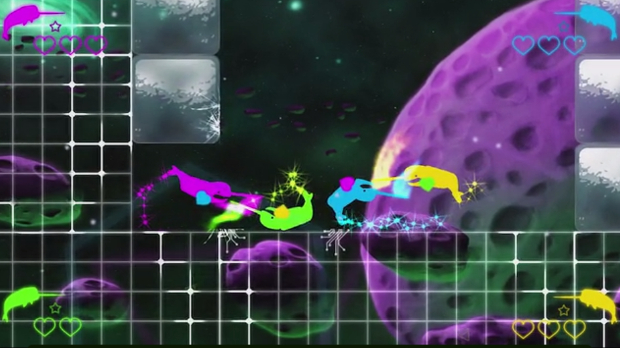
First Nidhogg finally became a reality for all and sundry, and now Starwhal has decided upon a release date too. It’s quite the month-ish for offbeat, high-skill melee games. Two-to-four-player, QWOPish, psychedelic whale-battler Starwhal: Just The Tip has gone from gamejammed quickie to decent Kickstarter success to A Thing That Is Being Released On February 17.
Put your horns in the air to celebrate. Missus.
Inevitably, it’s Steam Early Access rather than full release for now. I keep wanting to say rude things about Early Access, but I worry that maybe one day I’ll need it for the cat game I’m slowly making and then a bunch of strangers will call me a hypocrite. Maybe I’d better hedge some bets: Early Access can be good and Early Access can be bad. Sometimes it can be a bit of both. I just want to be friends with everyone.
Starwhal’s status is described as “a playable yet unfinished version of the game. We need more time to finish this project, but we at least want to get you guys playing what’s available as soon as we can. We’ll be launching the game with 2 multi-player modes at first then slowly rolling out the remaining modes as time goes on. Later we’ll also add new levels, new costumes, and other goodies.”
If you missed all the fuss, this is a ‘local multiplayer’ game, which means basically playing it from your sofa, though it hit enough stretch goals that there’ll be some singleplayer challenge modes in there further down the line.
Here’s a more visual reminder of what it’s all about:
Oh, whoops, that’s not it. Silly me!
Here you go:
That becomes a reality on February 17, on both PC and Mac flavours of Steam.
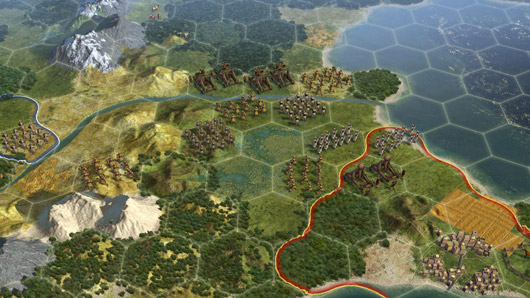
2K Games launched a DLC-bundled Complete Edition of Firaxis' life-consuming strategy game Civilization 5 today, serving up a meaty collection of expansions and map packs alongside the core Civ 5 experience.
Civilization 5: The Complete Edition includes the previously released Gods & Kings and Brave New World expansion packs, along with every add-on map pack released for the game to date. Featured content includes the Explorer's Map Pack, a trio of Civilization and Scenario Pack add-ons, and several entries in the Cradle of Civilization series of playable maps.
The compilation also includes the new Conquest of the New World Deluxe Scenario, which challenges players to relive Christopher Columbus's 1492 voyage across the Atlantic. The Deluxe Scenario is available as a free upgrade to players who previously purchased the Brave New World expansion pack on Steam, and will be bundled with all Brave New World purchases going forward. [Image: 2K Games]

Indie developer Sunken Places recently launched a Kickstarter project for Classroom Aquatic. The PC, Mac and Linux game uses, but does not require, the Oculus Rift virtual reality headset. In it, players assume the role of an exchange student that is completely unprepared for an exam in a classroom full of dolphins. In order to pass the test, players need to sneak glances at their neighbors' answer sheets without being caught by both the finned students and the teacher.
A demo version of Classroom Aquatic is currently available on the developer's official website. It is seeking $30,000 by March 5 to fund the full version, which will feature multiple languages, and more classrooms and mechanics than the demo has to offer.

We've all seen Transformers do their titular thing with ease but, when slowed down, it's quite the complicated and laborious process. There are a lot of hinges and gaskets and pistons that have to move around in different stages in order to turn a gigantic bipedal robot into an airplane.
That's exactly what's so interesting about this Kerbal Space Program video, which shows how user Hooptiej built a fully-transforming Starscream model into the game. It's not the exact Starscream we remember from the TV show when we were growing up, but it's impressive nonetheless.
Unfortunately, this version of Starscream isn't the most adept at flying. A few seconds after a clumsy take-off, Starscream came careening back to Earth - at least, that's what HooptieJ says. In the interest of saving face, the video cuts away before we can see Starscream crash. [Image: HooptieJ]

Hello youse.
As we build up to my historic announcement of the best board game of 2013, I think it’s worth taking a break to talk about an exciting new edition of a great game. I’m really pumped about how good this game is. Are you sitting down? Do you like dice? Do you like games with lots of replayability?
Okay then.
BATTLELORE 2ND EDITION
Oh shit, son.
This game system, this Richard Borg game system, this Command and Colors game system, this game system.
This game system.
When I got back into board games in a big way, many years ago now, Memoir 44 was one of the first games I picked up. It operated under Mr Borg’s incredible Command and Colors game system, and it was fantastic. In the years that followed, I picked up Command and Colors itself, and many other games that used the same basic ruleset. Games like Battles of Westeros and Abaddon and Battlelore. I loved them all.
Here’s a basic explanation of how the game system works. You have a board representing a battle map, laid out with hexagons. That board is split into three sections. Left flank, right flank, centre. You have units on your side of the board, and you draw cards from a deck. Those cards allow you to command your troops. A card might say “ORDER TWO UNITS ON THE LEFT”. Or it might say “ORDER ONE UNIT FROM EACH SECTION”. Then you move your troops and roll some dice to attack. The game system is, at its core, about managing your hand of command cards to get the best out of your troops. Essentially, this system only lets you command some of your troops some of the time, so you better get thinking about what you’re going to do next.
(The different versions of the game introduced different elements. Abaddon is more chaotic, with you rolling command dice to activate your robots. Battles of Westeros ties commands to the influence area of generals in your army.)
Battlelore introduced something else – Lore cards. Lore cards were cards with magical effects, or power boosts, or – look, put simply, Lore cards were “cool shit” cards. It was a great game.
But then – THEN…. A whole mess happened. Days of Wonder sold Battlelore to Fantasy Flight and then Fantasy Flight said it was too expensive to produce so no more printings came to light and then they introduced Battles of Westeros as a Battlore game and I have no idea why they did that and everyone got really angry because everyone really wanted more Battlelore and it looked like Battlelore was dead and the original edition got really expensive on the second hand market and everyone was pretty much totally pissed off at this point it was really horrible and I don’t like it when people fight.
But the dark days are over. Battlelore 2nd Edition is out. And it’s pretty much a slam dunk. And I don’t even know anything about baseball!
Okay, so those old game mechanics? Left flank, right flank, centre? Present and correct. Two armies in beautiful plastic. One red, one blue. Archers, dudes on horses, big monsters. Lots of tiles representing hills and forests and rivers and villages. A deck of command cards and a deck of lore cards for each army. All. Present. And. Correct.
Here’s something cool – when you are about to play a game, each player selects a scenario card that covers their side of the board. When two players put those cards together, it shows the full map, and how to set it up, and what special conditions are in play. This means you never really know what kind of battle you’ll be fighting until that stuff is revealed. It adds a lot of variety. There’s a “fog of war” mechanic too. When you set up your units at the start of the game, you’ll also place decoy units on the board. Your true placements are hidden. All of this stuff gives a real sense of drama to the start of a battle, and helps stop stuff sliding into predictability.
Battlelore, like all the Command and Colors games, is easy to learn and play. I think it flows so smoothly because you can only think about a few things at any one time. Because you are limited in your commands from moment to moment, it feels like you are zooming into different areas of battle. “I will think about this now” and then “I will deal with this now”. It’s always tense, but never overwhelming. There’s dice-chucking, sure, and every game under this game system will throw up a few moments of being horribly unlucky with the dice. But your opponent will have those moments too, and it’s your job to try to lessen the impact of your freak events.
The units are brilliant. There are these crazy barbarian fellas who get stronger the more hurt they get. So, if you attack them, you better hope you wipe them out. Otherwise, you’ve just pissed them off. There are archers with poisonous arrows. There’s a big giant bird thing with a guy riding on it. There’s flavour dripping everywhere. The two armies in the box, and those modular scenario cards you lock together, ensure you can play this thing forever.
But wait. There’s something else.
This just recently popped up on the Fantasy Flight site -
So, what do we have here? A brilliant edition of a brilliant version of one of the most brilliant game systems ever devised. A massive amount of variety in the box, and now a scenario builder that just kicks the whole thing open.
I’m sure I don’t have to say anything else. This shit is tried and tested. The safest of safe bets. Buy it.
"Duke Nukem kicks ass across planets in an Unreal Engine-powered galactic adventure to save the president from an apocalyptic alien threat," the translation reads. "All new enemies. A never-before-seen arsenal of devastating weaponry and series-first mechanics, including experience points and tech trees, will let Duke rip 'em a new one in a way he never has before."
Interceptor Entertainment is the studio behind Rise of the Triad and iOS ports of Duke Nukem games, and in December we noticed it was working on a PC and PS4 game dubbed "Project Ascender." 3D Realms handled 2011's Duke Nukem Forever with Gearbox Software, a relationship that ended with a canceled lawsuit and ... Duke Nukem Forever.
The timer on Duke Nukem: Mass Destruction's teaser site hits zero on February 25. [Image: 3D Realms]


Cuphead splits me right down the middle. It’s a run-and-gun game about one-on-one fights, which means it’s about learning attack patterns, dodging enemies, and striking back through multiple waves to eventually destroy them. It’s inspired by the likes of Contra and Mega Man, games which aren’t really my thing.
It’s also using hand-drawn cel animation, watercolour backgrounds and live jazz recordings to mimic the style of early, 1930s cartoons. In its videos, it looks like a controllable, early Mickey Mouse cartoon with a lot more fighting. It’s exactly my kind of thing.
To continue the theme of animated GIFs selling me on games, check out Cuphead’s Steamboat Willie-style idle animation:
I’m in love.
That Cuphead video is from October last year, and a post from November on the developer’s blog goes into more detail about what kind of game they’re making:
Cuphead is a classic run and gun that centers around 1-on-1 fights (2-on-1 in two player mode).
With Cuphead, we aim to evolve the genre by adding new features such as: super arts, infinite lives, a playable world map and hidden secrets. In addition to that, we will have refined controls, additional boss patterns on harder modes and balanced weapons to equip (that you don’t lose!). We plan to release 10-15 bosses per episode and end up with over 30 bosses.
They mean “super arts” in the fighting game sense, but they could also be talking about their animation. Which is super. And art…
Look at that GIF! There are more videos over at the Cuphead site, and the game is due for release later this year.

Richard Mitchell will be (awkwardly) controlling Octodad's gelatinous gyrations while Ludwig Kietzmann will be hanging out in the chat room taking questions and comments about the game. If you'd like to participate in the live conversation, head over to Joystiq's Twitch channel at 4pm Eastern! [Image: Young Horses]

This is almost too ridiculous, but it’s got pedigree. Julien Cuny and Louis-Pierre Pharand, former producers and creative directors at Ubisoft on Assassin’s Creed and FarCry, have formed a new development studio named PIXYUL. Their goal: to map our planet at 1:1 scale using drones, and use the resulting 3D recreation as the setting for a survival RPG called ReRoll.
Video below which shows, at least, that they are not joking.
When I was a kid, I used to dream of playing a game of hide-and-seek which would encompass the entire town in which I lived. The idea of turning that small suburban space into an enormous game seemed thrilling. A lot of the appeal of DayZ for me lies in that feeling: of taking ordinary, urban spaces, with all their stretches of dullness, and re-contextualizing it as a game of tension and hide-and-zombies.
So I’m inclined to like ReRoll for its goals, even if I am skeptical of its methods. Does that even need saying? They want to map the surface of the planet with small drones. Even if, as the site explains, they plan on skipping certain areas – Antarctica, the Amazon rainforest – I think that might take a while.
It’s also going to take a lot of money. Right now, PIXYUL are no more than they’re two founders, and they’re turning to crowdfunding – surprise – to get the money they need to make the game. They’re not using Kickstarter, but running everything through their own site. There an explanation of the funding tiers here, and there’s an online shop in which you can purchase characters or bundles of characters.
For the game that doesn’t exist yet. Set on the level the size of planet earth.
If you’d like to know more about what kind of game will actually take place on this digital recreation, they’ve got a page about that as well. From the little bit of (mock-up, it looks like) footage in the trailer above, it’s a top-down action RPG about foraging, fighting, crafting. Like Wasteland 2, but with a 24-hour day/night cycle and a planned system to sync the in-game weather to real weather, and also I guess with just huge stretches of space where it’ll be no fun to ever go or be. Like Hull. Imagine if you spawned in Hull.
To be fair, the money people give them will go towards creating “Brick 1″, a much, much smaller chunk of the world (a few square kilometers) which they can build systems around and release. From there, they’ll slowly start expanding into new areas. So if it proves a popular idea or a compelling game, it’s technically and financially feasible that they could expand from there.
But I wish they hadn’t opened with, ‘we want to map the whole world with drones’. It’s a lure, designed to suck you in with its futuristic ambition and absurd scale. The reality is they want to create an isometric RPG, haven’t made much of it so far, and would like you to pay for them to continue. That’s fine, that’s what everyone else is doing, but I wish they had pitched what they were likely to complete in the next, say, five years, rather than opening with, ‘This is what we’ll make assuming we receive an unfathomable amount of funds.’
"The game is already in an advanced state of completion - which includes about 12 hours of gameplay, most of the main game features and the first two chapters of the campaign," noted Kasedo Games in the announcement. The ready-for-primetime version of the game will be on PC this spring. [Image: Kasedo]

First there was the nerdly Gates, then there was the terrifying Ballmer, and now there is Satya Nadella. What will be the brand new CEO of Microsoft’s ‘thing?’ Perhaps he’ll present keynotes dressed in a lion-themed onesie. Perhaps he’ll have the Windows Vista logo branded onto his chin in order that the company never forgets its past mistakes. Perhaps he’ll cry softly throughout board meetings. Or perhaps he’ll be quietly capable and manage to set the great, barnacle-clad ship Microsoft back on course after its triple-whammy of big commercial wobbles, Windows 8, Windows Phone and the Surface RT tablet*. Perhaps he’ll suddenly make the company interested in PC games again. Or perhaps he’ll oversee some new version of Windows so misjudged that Steam OS finds it has an open goal.
Who knows? But change for a company that, outside of its consoles, has been facing an uphill battle for home computing relevancy of late, is in principle a good thing. And hey, who’da thunk it: he only scores two out of three in Middle-Aged White Guy CEO bingo. Progress of a sort!
Satya Nadella probably isn’t a name that has oft reached relative laymans’ ears, but he’s been at MS since 1992 – i.e. since the halcyon days of Windows 3.1 – so this isn’t perhaps a case of the firm reaching outside its comfort zone, as some onlookers have felt it needs to if it’s to go toe-to-toe with the Apple threat. However, he will be aided by one William Henry Gates III.
A sideways step for Microsoft’s founder and original CEO sees him moved from ‘chairman’ to ‘founder and technology advisor’, which reportedly means he’ll be much more involved in product development once again, following half a decade in which he was essentially hands-off. Whether the old man has too much blood left in him when it comes to devising gotta-have tech remains to be seen, of course, but broadly he’s perceived as helming MS during its glory days (as opposed to Sweaty Steve Ballmer during its slow decline on the computing front), so there’s plenty of industry excitement about this.
Here’s old Billy Boy talking about MS’s new CEO, his own new role and what he hopes it means for the company:
Aw, look how cute he is when he clasps his hands together and looks hopefully at the camera at the end.
Said Nadella, who’s spent recent years focusing on servers, clouds and that sort of thing, “Microsoft is one of those rare companies to have truly revolutionized the world through technology, and I couldn’t be more honoured to have been chosen to lead the company. The opportunity ahead for Microsoft is vast, but to seize it, we must focus clearly, move faster and continue to transform. A big part of my job is to accelerate our ability to bring innovative products to our customers more quickly.”
I.e. be more Apple, presumably. Well, we’ll see. I do suspect an increased focus on tablets and phones more than I do on PCs, but a) perhaps that leaves more room for real change in PC-land b) at least some degree of phone/tablet/PC convergence seems inevitable.
Here’s Nadella in action, as it were, in a not at all awkward** walk’n'talk interview.
I particularly like the way they end up in a room which for some reason has a scooter and walls made of leaves in it. “Hey look kids, Microsoft is a fun company after all!”
Anyway, Mr Nadella also seems very nice. Although he does use the phrase ‘ruthlessly remove’ at one point.
Interesting times. I am really going to miss this, however:
At least there’s the prospect of more of this:
My word. Just look at his hipster glasses.
* I should note here that I’m extremely fond of my Surface Pro 2, which runs full-fat Windows rather than the hamstrung RT version. ** Quite awkward.

To coincide with a week-long Steam sale, the enigmatic MirrorMoon EP has expanded its repertoire of planetary structures, adding objects that pay homage to various games, including Kentucky Route Zero and Gone Home. It’s entirely possible that I made a huge mistake when I allowed this one to slip off the frighteningly extensive list of games that I intend to play. I did noodle around with the prototype, which introduced the puzzling concept hinted at in the game’s title, but have only visited the full release a couple of times. It reminds me somewhat of Starseed Pilgrim, in that it lacks guidance or instruction but is constructed around concepts of puzzle and play rather than being a ‘go for a walk’ experience. The game is currently £4.19 through Steam, a 40% discount that firmly plants it in actual EP territory.
How does it all work? I don’t really know but it starts like this – the player is upon a planet with a single moon hanging in the space above like a malevolent and mysterious disco ball. Strange objects and structures are strewn about the surface of planet and moon alike and the discoveries on either one are mirrored on the other. Initially obtuse, the full release punched me in the neural tissue, but as exploration through the galaxy continues, the journey is a bit like sorting through the spilled remnants of a thousand alien toyboxes.
We just pushed to Steam our latest update for MirrorMoon EP, hopefully fixing some of the issues you might have encountered and adding some extra secrets especially for those of you who have been exploring extensively in the last few months.
Join us in Season 32 to discover new, extremely rare, artifacts! Thank you for playing!
I’m determined to learn more of its secrets but am slightly intimidated by the fact that I’ve already missed out on 31 ‘seasons’. They’re all available to play with and, if I understand correctly, a new season is opened as soon as certain planets on the current galaxy are discovered and named by players. There’s no continual narrative to catch up on but the community currently scouring the planets and their moons have probably evolved into star children – do they really need me to join them, scratching my head by the side of my Commander Keenesque craft?
For more on MirrorMoon, read the fine words of Duncan Harris. That article also mentions Captain Blood, which automatically makes it one of the best articles.

Chat
