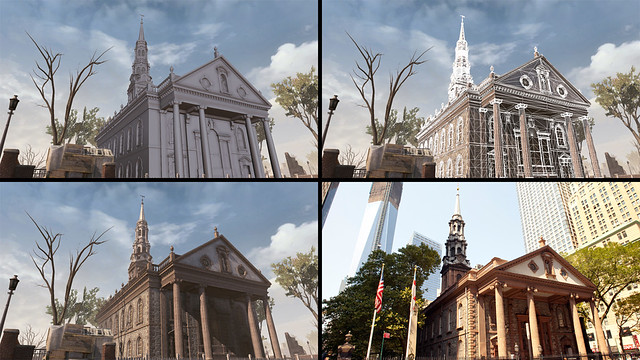
Part of Assassin’s Creed III’s ample appeal lies in its fastidious recreation of Revolutionary War-era America, a time of great uncertainty and even greater promise. Developer Ubisoft Montreal has gone to considerable lengths to accurately recreate historic locations across the U.S. Eastern Seaboard, referring to era maps and historians in order to bolster the game’s authenticity.
We recently spoke with lead designer Steve Masters and creative director Alex Hutchinson to learn more about the game’s slavish attention to detail in recreating late 18th century colonial America. Enjoy!
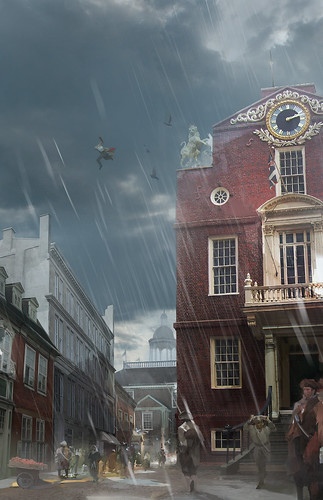
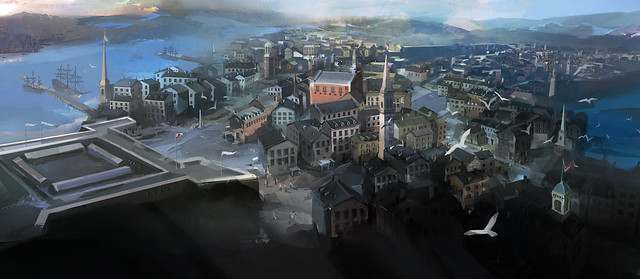
 “In Boston, you’ll see a lot of places you could see today, from the old statehouse to Fenway Market to a pub called the Green Dragon Tavern. Using maps from the era, we recreated Boston at a 1:3 scale, including a lot of the surrounding countryside with towns like Lexington and Concord.”
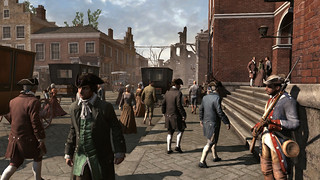
– Steve Masters, Lead Designer, Assassin’s Creed III “One of my favorite details is how we’re bringing the crowd to life in a more dynamic way: rats, pigs, goats, sheep, are all sharing the streets and it gives a different ambience. We’ve also got kids for the first time, and seeing that difference in height gives a richer feel to the crowd life.”
– Steve Masters, Lead Designer, Assassin’s Creed III
“One of the most challenging things with a city like Boston is the road layout. There are a couple of big, straight streets that our tech really was not set up for, so we had to create a lot of new tech to populate those big streets with people and make sure that can see them way out into the distance.”
– Steve Masters, Lead Designer, Assassin’s Creed III
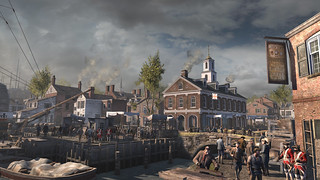 “There was also the big question, what’s going to be an interesting landmark to climb? Take the architecture of houses of this era — roofs had a pretty steep pitch, and that’s something we wanted to represent in the game. But changing the architecture meant we had to adjust the way the character plants his foot. Supporting fighting on this steep sloped terrain…it was all stuff that was new for us, and really challenging. It just took a lot of care and time.”
– Steve Masters, Lead Designer, Assassin’s Creed III
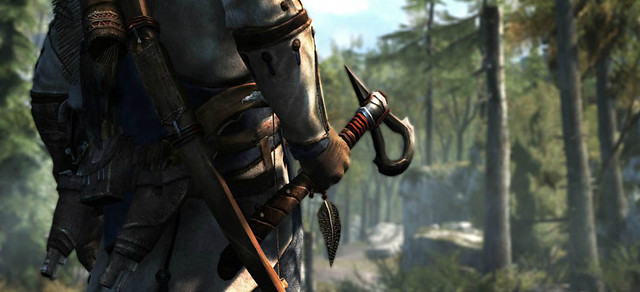
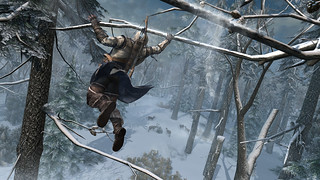
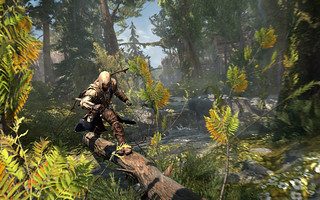 “You’ll go to Valley Forge, you’ll go to Bunker Hill…There are a wide variety of environments you’ll encounter, from pine forests to swamplands to rolling plains and old-growth forests. You’ll see bears fishing the river, wolves howling on a cliff, bobcats sunning themselves…”
–Steve Masters, Lead Designer, Assassin’s Creed III “The frontier is an amalgamation of all parts of the American Northeast, it’s a huge chunk of America condensed into a smaller space. When you reach the frontier, we wanted the feeling that it’s you versus the elements — that sense of untouched wilderness.”
– Alex Hutchinson, Creative Director, Assassin’s Creed III “There are 26 animal types in the game, from beavers and deer to wolves and bears, and you can even use bait to attract certain kinds of animals. This is really fun if you bait wolves to a British convoy, which will obviously end in carnage.”
–Steve Masters, Lead Designer, Assassin’s Creed III